


Global News & Trends | Nolan Voss
The recording starts with a sound you rarely hear in a metropolis of three million people: silence. Not the peace of a library, but the suffocating, heavy dampening of sound that happens when the air itself becomes an obstacle. Then, a low mechanical hum cuts through—the idle engines of a thousand stalled electric haulers. A voice, breathless and clipped, narrates the visibility: “I can’t see the hood of the truck. The sensors are screaming. The whole grid is red.”
This isn’t a scene from a dystopian film; it is the reality of the Sheikh Zayed Road this week.
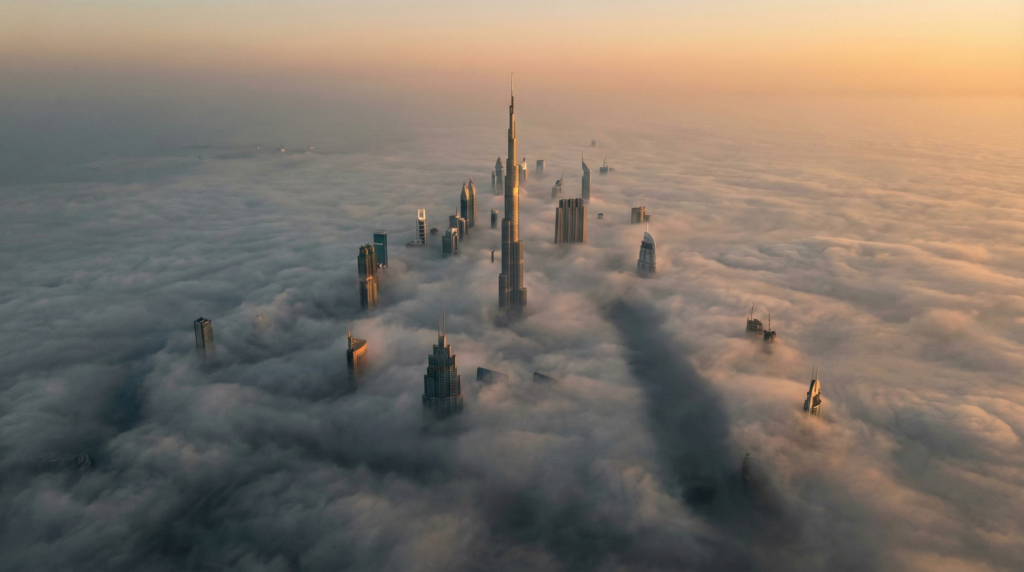
On February 7, 2026, the United Arab Emirates issued a rare “Red Alert,” a designation usually reserved for the most violent storms, not for silence. A super-dense fog event—the most severe since 2025—didn’t just lower visibility; it effectively deleted the horizon. For five days, the glistening nodes of global commerce, Dubai and Abu Dhabi, were wrapped in a blinding cotton wool that baffled LIDAR, grounded fleets, and exposed a terrifying fragility in our high-tech urban planning.


The Anatomy of a “Whiteout”
To understand why this week’s advisory matters, we have to look past the canceled flights at DXB. This wasn’t standard winter mist. Meteorological data suggests we are witnessing a compounding phenomenon: the “Super Fog.”
In the 20th century, fog was a nuisance. In 2026, it is a logistical weapon. The audio recording hints at the panic on the ground—automated systems failing to interpret the density of the moisture. When humidity hits 100% in an environment saturated with hygroscopic (water-attracting) particulate matter from industrial zones, the water droplets don’t just hang; they bond. They form a wall.
The “Smart” Failure
The irony is palpable. We spent the last decade building “Smart Highways” equipped with V2X (Vehicle-to-Everything) communication to eliminate traffic jams. Yet, as the Red Alert proved, physics still trumps code. The smart gantries dropped speed limits to 80 km/h, then 40, then effective zero. Autonomous trucking fleets, the lifeblood of the Jebel Ali port, were paralyzed. Their optical sensors were blinded, and their radar returns were scattered by the sheer density of the moisture. We built a system for speed, but we forgot to build eyes that can see through the dark.


Myth vs. Reality: The Climate Connection
There is a comfortable myth circulating in the European press that this is just “desert weather.” The reality is far more uncomfortable.
- Myth: Fog is natural and harmless.
- Reality: The frequency of these “Red Alert” fogs has increased by 15% in the last decade. This is directly linked to the warming of the Persian Gulf (increasing moisture supply) colliding with rapid urbanization (creating “heat islands” and particulate nuclei for fog to cling to).
We are engineering our own blindness. The massive terraforming projects and artificial islands have altered local microclimates, slowing down the wind shear that used to scour the fog away. We are trapping ourselves in a sauna of our own making.
The Trillion-Dollar Blindspot
The true cost of the “Great Fog of ’26” isn’t in delayed vacations; it’s in the supply chain. When Dubai stops, a significant percentage of the world’s air cargo stops.
The audio captures a snippet of a port authority broadcast: “Berth schedules suspended. Swells at 40km/h.” This is the heartbeat of global trade skipping a beat. Pharmaceuticals destined for Europe, electronics for Africa, perishable foods—all sitting in a grey limbo. As “Just-In-Time” delivery models try to recover from the shocks of the early 2020s, weather events like this act as a stress test that we are currently failing.
If a 72-hour fog can snarl the logistics of the most advanced logistics hub on Earth, what happens when the fog doesn’t lift for a week?

The Big Picture: Navigating the Grey
The dense fog advisory of February 2026 is a warning shot. It reminds us that for all our sensors, algorithms, and predictive models, we are still inhabitants of a volatile planet.
The future of logistics isn’t just about speed; it’s about sensory resilience. We need radar that penetrates hydro-walls. We need AI that can navigate “blind” with the confidence of a bat, not the hesitation of a camera. And perhaps, most importantly, we need to respect the atmosphere we are so busy modifying. Until we do, we will remain like the voices in that recording: waiting in the whiteout, hoping for the air to clear.
Would you like me to draft a follow-up piece analyzing the specific “Radar vs. Lidar” technology gap that caused the autonomous fleet failures during this event?