


🔍 Deep Dives & Analysis | Leo Stratus
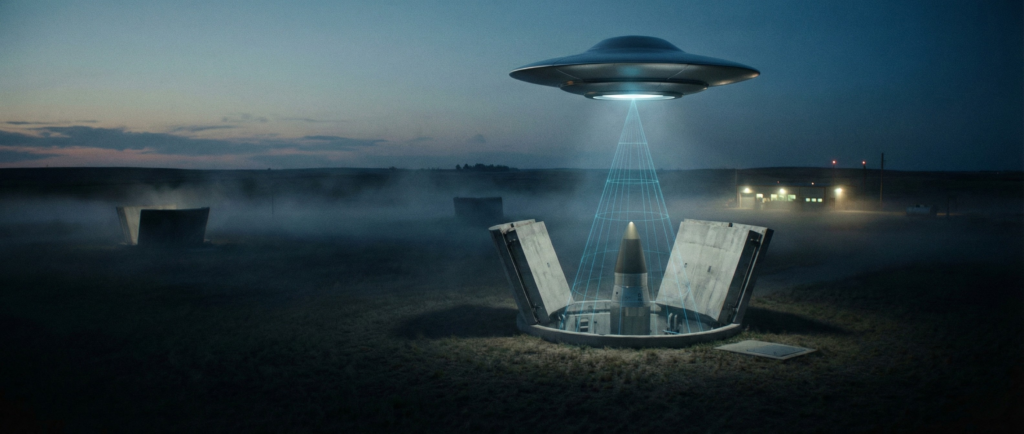
It starts with a blip on a radar screen, a shadow falling over a hardened concrete silo, or a sudden, unexplained system failure that leaves the world’s most destructive weapons temporarily useless. For decades, a silent narrative has run parallel to the history of the atomic age: the persistent, unnerving presence of Unidentified Aerial Phenomena (UAPs) in the immediate vicinity of nuclear weapons facilities. This isn’t just folklore for the tinfoil-hat brigade; it is a pattern corroborated by declassified military documents, radar data, and the testimonies of high-ranking Air Force officers who were there when the consoles went dark.
Why are they watching? Are these visitors interstellar peacemakers, cosmic anthropologists, or scouting parties assessing a threat? The correlation is too precise to be coincidental. From the deserts of New Mexico to the forests of Suffolk, wherever humanity stores the fire of the gods, someone—or something—seems to be keeping score. In this investigation, we peel back the layers of secrecy surrounding the “nukes and UFOs” connection, exploring whether our greatest weapon is actually a beacon, signaling our technological adolescence to the stars.

The Malmstrom Incident: A Chilling Precedent
To understand the scope of this phenomenon, we must look back to the seminal event that defines the narrative: the 1967 incident at Malmstrom Air Force Base in Montana. Deep research into the archives reveals a scenario that reads like science fiction but is documented fact. According to Captain Robert Salas, a launch officer on duty, a glowing red orb was reported hovering over the front gate. Seconds later, deep underground, the “No-Go” lights flashed on his console. One by one, ten Minuteman nuclear missiles dropped offline. They weren’t physically damaged; they were electronically isolated, rendered inert by a force we couldn’t comprehend, let alone counter.
This was not an isolated glitch. Similar incursions occurred at Minot AFB and international sites like Rendlesham Forest (near a suspected nuclear storage depot). The “myth” here is that these are simple equipment failures or swamp gas. The “reality,” supported by the sheer volume of corroborating witnesses, suggests a technology capable of remotely manipulating shielded, analog, and digital military hardware. The implications are staggering. If an intelligence can turn our weapons off, could they also turn them on? Or is the message simpler: “You are playing with matches in a room full of gasoline.”

The Audio Insight: A Warning from Above?
echoing the sentiments of researchers like Robert Hastings. The speaker delves into the psychological and sociological reasons behind this extraterrestrial interest. The core argument extracted from the recording suggests that our development of nuclear fission was a “loud” event in the cosmic neighborhood. It wasn’t just a weapon; it was a signal that humanity had reached a dangerous threshold—capable of destroying not just itself, but potentially impacting the fabric of spacetime or the local galactic environment.
The transcription implies that these visitations aren’t hostile invasions but rather containment protocols. Just as human scientists might tranquilize a dangerous animal to tag it or remove a hazard from its habitat, these UAPs appear to be neutralizing a threat. The audio discusses the theory that the “Zoo Hypothesis” is in effect: we are being observed, and our nuclear toys are the only things that prompt the “zookeepers” to intervene directly. This aligns with the “Guardian” theory, positing that we are being protected from our own self-destruction until we mature as a species.


Modern Disclosures and the Future
Fast forward to the modern era, and the narrative hasn’t changed—it has only gained legitimacy. The Pentagon’s AATIP (Advanced Aerospace Threat Identification Program) and the recent congressional hearings have subtly acknowledged that UAPs have an interest in our military capabilities. While the official language is sanitized—referring to “national security concerns”—the subtext is clear. We are still being watched. The 2004 Nimitz encounter, while naval, involved a strike group powered by nuclear reactors. The connection to nuclear energy remains the strongest predictor of UAP activity.
As we stand on the precipice of a new arms race, with hypersonic missiles and tactical nukes re-entering the geopolitical conversation, the question remains: will the “watchers” intervene again? Or was the shutdown at Malmstrom a singular warning that we failed to heed? If the audio insight holds true, we might expect an increase in sightings as global tensions rise. We are not alone in this room, and the other occupants seem very concerned about the grenade we’re holding.


Do you believe these interventions are acts of protection or preparation? Share this article with your theories and check out our next piece: “The Physics of the Impossible: How UAPs Defy Gravity.”