


Deep Dives & Analysis | Dr. Elara Quinn
For 4,500 years, the Great Pyramid of Giza has stood as the ultimate silent witness, mocking us with a single, maddening question: How? We have thrown every theory at it. We’ve imagined mile-long ramps that would require more stone than the pyramid itself. We’ve proposed internal spiral tunnels that would leave workers blind in the dark. We’ve even, in our desperation, looked to the stars and blamed aliens. But the problem isn’t that we can’t find the evidence of construction; the problem might be that we are looking for the wrong kind of evidence. What if the ramps, the cranes, and the debris didn’t disappear? What if they are staring us right in the face, disguised as the monument itself? A radical new theory proposes that we have been watching the movie in reverse. The Egyptians didn’t just stack blocks to the sky—they built a mountain, then carved a miracle out of it.


The Ramp Problem
To understand why this new idea is shattering archeological conventions, you have to look at the “Ramp Problem.” Mainstream history suggests workers hauled 2.3 million stone blocks up a massive earthen incline. It sounds plausible until you do the math. To keep the slope gentle enough for human laborers (about 7 degrees), the ramp would need to be over a mile long, consuming more material than the pyramid itself. And where did it go? There is zero archaeological evidence of a debris field large enough to account for a dismantled ramp of that size. The alternative—a spiral ramp—fails the “Apex Test.” As you get closer to the top, the working area shrinks. By the time you reach the capstone, you have no room to stand, let alone maneuver multi-ton granite blocks with the laser precision required to align the peak to true North. The silence of the desert regarding these construction methods has been deafening.

The “Unbuilding” Insight
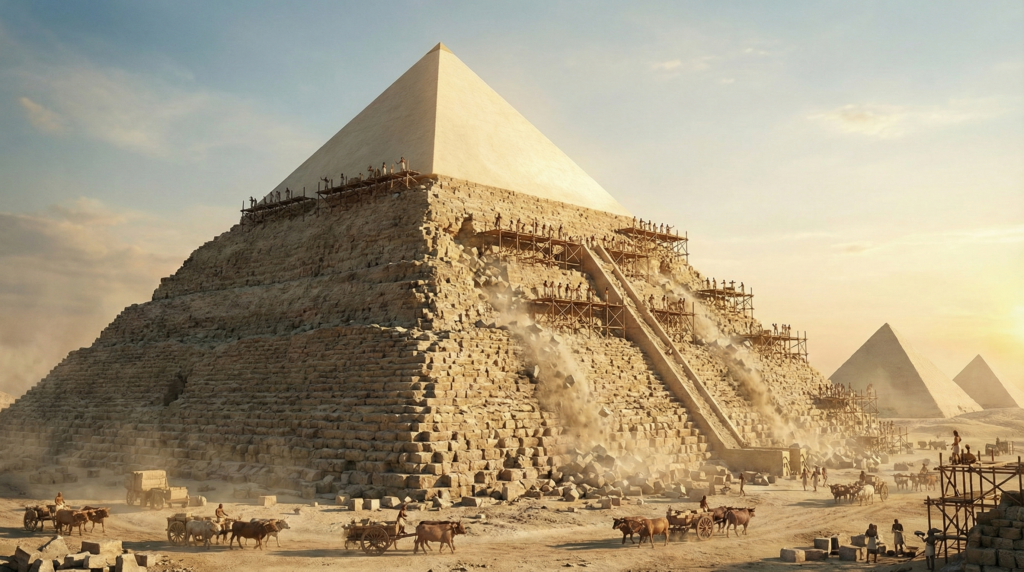
Enter Huni Choy, an independent researcher who spent a decade modeling every stone at Giza, and his “Unbuilding” theory. The core concept is terrifyingly simple: The Egyptians didn’t build a pyramid; they built a Trapezoidal Step Mass. Imagine a massive, blocky, over-sized mountain of stone, significantly larger than the final structure. By using the natural limestone outcrop and piling rough blocks into a gigantic platform, they created a structure with a wide, safe working deck at the top. They didn’t fight gravity on a narrow ledge; they conquered it with a massive artificial floor. Once this “overbuilt” mass reached the necessary height, the real work began. They started at the top and worked downward.

The Cannibalization Loop
This is where the genius of the theory locks into place. As the workers carved the rough step mass into the smooth, geometric perfection of the pyramid, they generated millions of tons of “waste” stone. In the traditional model, this waste is a mystery. In the “Unbuilding” model, it is the fuel. The debris cut from the first pyramid wasn’t thrown away; it was immediately recycled to build the step mass for the next pyramid or the surrounding temples. The Giza Plateau wasn’t just a construction site; it was a closed-loop manufacturing engine. This explains why there is no massive debris pile—it’s hidden in the walls of the neighboring structures. It also solves the precision issue. When you carve from the top down, you have full visibility of all four corners. You aren’t guessing where the point will be; you are standing on it, shaving away everything that isn’t the pyramid.

Rewriting the Timeline
This theory essentially suggests that the pyramids are “sculptures” rather than just masonry projects. It aligns with the Egyptian obsession with purity and subtraction—the idea of revealing the sacred form hidden within the stone. Recent muon tomography scans have revealed inexplicable voids and density variations that don’t fit the spiral ramp theory but could align with the remnants of internal access tunnels used during this “unbuilding” phase. If Choy is right, we have underestimated the logistical brilliance of the Old Kingdom. They didn’t just have manpower; they had an algorithmic efficiency that rivals modern manufacturing. The missing evidence isn’t missing. We’ve just been looking at the finished product, unable to see the scaffolding because the scaffolding became the next monument.

Next time you see a picture of Giza, look at the smaller pyramids next to the Great One. You might not be looking at separate tombs, but the recycled “scraps” of the greatest engineering feat in history. Share this theory and ask your friends: built up, or carved down?