


🔍 Deep Dives & Analysis | Nolan Voss
The annals of criminal history are filled with brilliant detectives, lucky breaks, and technological marvels. We’ve seen cases busted wide open by fingerprint dusting in the 1900s, the advent of DNA profiling in the 80s, and algorithmic predictive policing in the modern era. But sometimes, the most effective informant isn’t a human with a conscience or a supercomputer with a database; sometimes, it’s a six-legged biological drone driven purely by hunger. In the realm of “truth is stranger than fiction,” few stories rival the 2008 incident in Finland where the primary witness for the prosecution was a deceased, blood-engorged mosquito. This wasn’t a scene cut from CSI: Miami for being too implausible; it was a watershed moment in forensic science that blurred the lines between biology and surveillance, proving that in the modern world, you truly leave a trace of yourself everywhere—even inside other living creatures.

While forensic entomology—the study of insects related to legal investigations—is usually employed to determine time of death based on maggot development cycles on decomposing bodies, the Finnish case required a radical rethink of biological evidence. The core scientific challenge here is the stability of human DNA inside an insect’s digestive tract. When a female mosquito takes a blood meal, she is essentially performing a biological biopsy. For a brief window, that blood remains relatively intact in her gut before her digestive enzymes break down the genetic material. Research subsequent to similar cases has indicated that a viable human DNA profile can be generated from a mosquito’s blood meal up to roughly 24 to 48 hours after feeding, depending on environmental temperatures and the species of the insect. This creates a ticking biological clock for investigators. They aren’t just looking for the insect; they are looking for an insect that feasted recently and then immediately died, preserving the evidence inside its tiny, chitinous body like a biological time capsule.

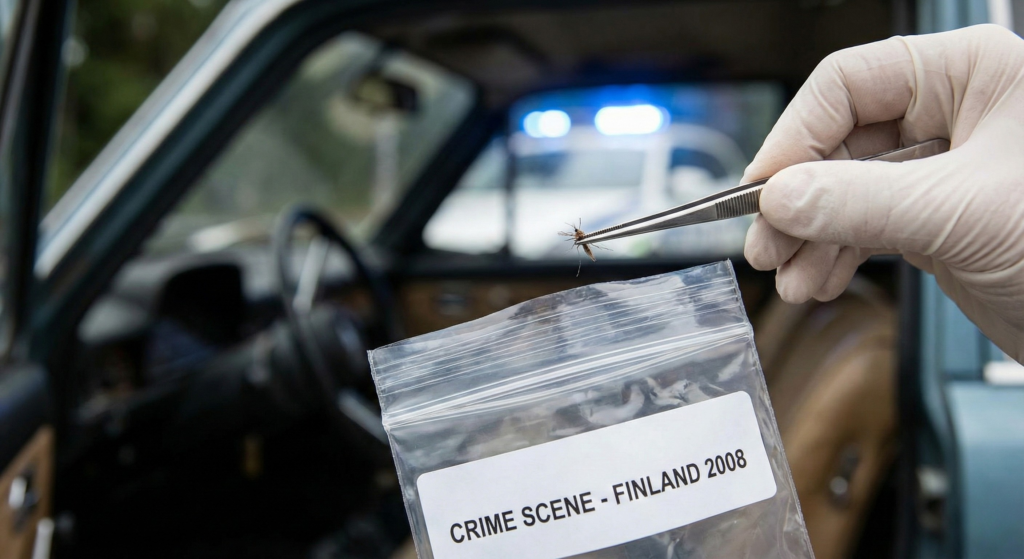
The narrative of the actual event is almost comical in its simplicity versus its scientific weight. As transcribed from recent reports on the case, the story unfolds like a bizarre movie plot that happens to be true. In 2008, in the town of Lapua, Finland, a vehicle was reported stolen. The police eventually located the abandoned car, but it was wiped clean—no fingerprints, no hair fibers, zero conventional evidence pointing to the perpetrator. The trail was completely cold. However, during a meticulous sweep of the vehicle’s interior, a sharp-eyed investigator spotted something minuscule: a dead mosquito. It was a long shot that bordered on ridiculous, but the police decided to send the insect to the lab to see if the blood it had drunk could be analyzed. The results were shocking. The lab successfully extracted a DNA profile from the blood meal, ran it through the national database, and got a perfect match to a known criminal already in police records. For the first time in recorded history, a mosquito effectively “pointed the finger” at a thief, leading to an arrest based purely on the blood it had stolen from the suspect.

This case was a novelty in 2008, but today, it serves as a harbinger of a future where “privacy” is a obsolete concept at a biological level. If a mosquito can incriminate you, what about the dust mites feeding on your dead skin cells in a hotel room? What about the traces of saliva left on a communal coffee cup? This moves us into the era of “Touch DNA” and trace biomonitoring, where the tiniest fragment of genetic material can place a person at a scene. It raises profound ethical questions about consent and surveillance. While we cheer for the capture of a car thief, the technology implicitly suggests a world where our biological exhaust forms a permanent, searchable record of our movements and interactions. We are entering an age where the environment itself—down to the insects flying through it—can be deputized by the state as silent, genetic witnesses.

Dive deeper into the ethics of genetic privacy. Read Jasper Kole’s editorial: “The Glass House of Genetics: Are We Ready for Total Bio-Transparency?