


🧬 Science & Discovery | Dr. Elara Quinn
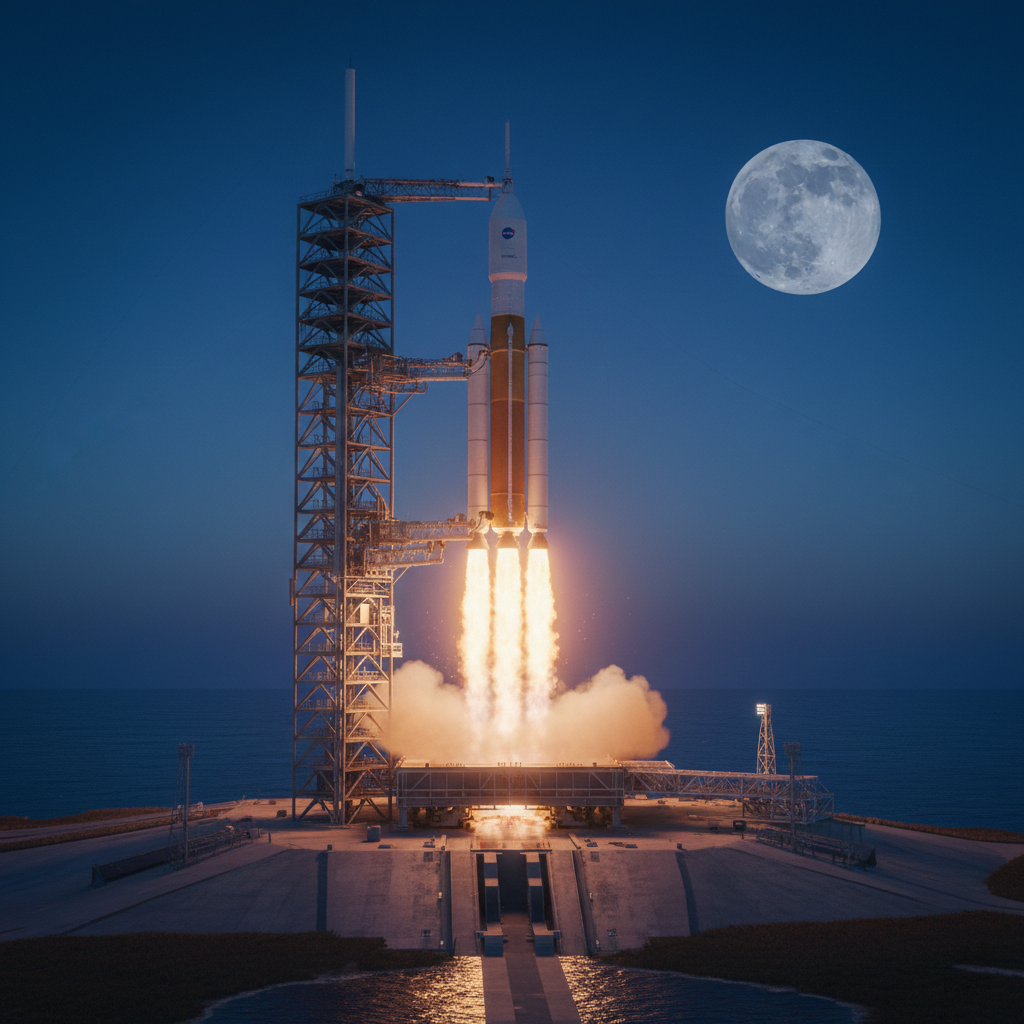
For over half a century, the lunar surface has remained a silent monument to the Apollo era. But the stillness is about to be shattered. This February, NASA isn’t just launching a rocket; they are launching a new era of human existence. The Artemis II mission represents the definitive bridge between our storied past and a multi-planetary future. This isn’t a mere “revisit”—it is a high-stakes stress test of the most powerful technology ever conceived by human hands. As the world watches, four elite astronauts will strap into the Orion capsule, perched atop a pillar of fire, to go where no human has ventured since 1972. The goal? To prove that we are no longer just visitors to the stars, but residents in training.

Deep Dive
The sheer physics of the Artemis II mission are staggering. To break Earth’s gravitational shackles, NASA is deploying the Space Launch System (SLS), a behemoth that stands as one of the most powerful rockets ever built. Generating a mind-numbing 8.8 million pounds of thrust—15% more than the legendary Saturn V—the SLS utilizes four RS-25 engines fueled by cryogenic liquid hydrogen and liquid oxygen. Within the first 120 seconds of flight, the twin solid rocket boosters provide the lion’s share of the power needed to punch through the thickest layers of our atmosphere. But the real “Deep Dive” mystery lies in the trajectory: the Trans-Lunar Injection (TLI). This isn’t a straight line; it’s a complex gravitational dance where the Orion spacecraft must hit a specific “keyhole” in space to be captured by the Moon’s gravity without crashing or slingshotting into the void.

Mission Mechanics
The ten-day mission profile is a masterclass in precision engineering. Once the SLS reaches orbit, the Orion capsule—housing a diverse crew including the first woman and person of color to fly a lunar mission—undergoes a rigorous check-out period. Unlike the Apollo missions, Artemis II will travel 4,600 miles beyond the far side of the Moon. This “Dark Side” transit means the crew will be the first humans to personally witness the rugged, crater-scarred lunar landscape that never faces Earth. The stakes are physical as well as technical; during re-entry, the capsule will slam into Earth’s atmosphere at 25,000 mph, generating temperatures of 5,000 degrees Fahrenheit. The crew will experience forces four times their own body weight, a punishing reminder of the violent transition from the heavens back to our home soil.

Myth vs. Reality
Public skepticism often asks: “Why haven’t we gone back sooner?” and “Is this just a repeat of Apollo?” The reality is far more complex. While Apollo was a sprint to win a geopolitical race, Artemis is a marathon designed for sustainability. The “Myth” that we are just doing the same thing is debunked by the tech: the Orion’s life support systems are designed for months, not days, and the mission serves as the ultimate rehearsal for Artemis III—the actual landing slated for 2027 or 2028. Furthermore, Artemis II is investigating deep-space radiation effects on the human body, a crucial data set that was largely unavailable in the 1960s. We aren’t going back to the Moon to leave footprints; we are going back to build a gateway to Mars.

The countdown has begun. Are we witnessing the birth of a space-faring civilization or a final curtain call for lunar exploration? Subscribe to Spherita’s newsletter for live telemetry updates and deep-dive technical breakdowns as we approach the February launch window.