Autophagy | The Body’s “Hidden Power” That Slows Down Time
Elara Quinn
By Dr. Elara Quinn-Science & Innovation Editor
Imagine if your house could clean itself. Not just a quick sweep, but a deep, structural renovation where broken windows are replaced, trash is recycled into fuel, and the foundation is reinforced—all without you lifting a finger.
This isn’t science fiction. It is happening inside your body right now.
It’s called Autophagy. For decades, it was a biological mystery, a “hidden power” locked within our genetic code. But thanks to a Nobel Prize-winning discovery, we now know this mechanism is the closest thing we have to a Fountain of Youth. It is the body’s built-in recycling plant, a system that hunts down “zombie cells,” devours them, and turns them into fresh energy.
But here is the catch: in the modern world of constant eating and sedentary living, most of us have accidentally switched this power OFF.
Today, we are diving deep into the science of self-eating (yes, really), why it scares the pharmaceutical industry, and the three proven ways you can flip the switch back on.
The Science: What is Autophagy?
The word comes from Ancient Greek: Auto (self) and phagy (eating). Self-eating.
While that sounds like the plot of a horror movie, it is actually the most elegant survival mechanism in biology. Your cells accumulate trash over time—misfolded proteins, damaged mitochondria (the cell’s batteries), and fragments of viruses. If this trash piles up, it leads to aging, Alzheimer’s, and cancer.
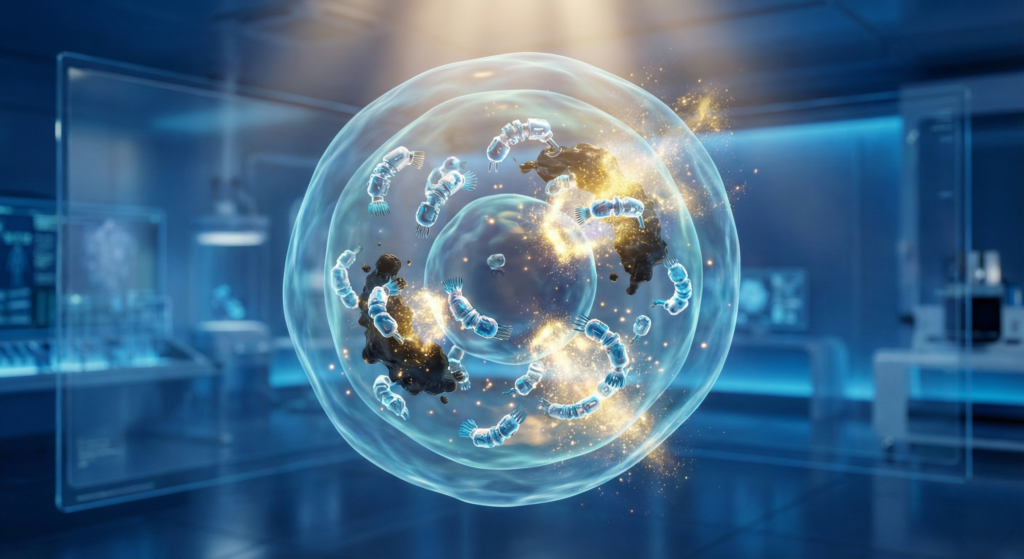
Autophagy is the cleanup crew. When activated, your cells create specialized “trash bags” called autophagosomes. These bags hunt down the cellular junk and deliver it to the lysosome—an acid-filled incinerator inside the cell. The lysosome melts the trash down and recycles it into raw amino acids.
Simply put: Your body eats its own damaged parts to build new, younger versions of itself.
💡 Fact Check:
The concept isn’t new, but the mechanism was unknown until Yoshinori Ohsumi cracked the code. His brilliant work with baker’s yeast identified the specific genes that control this process, earning him the 2016 Nobel Prize in Physiology or Medicine. He proved that this isn’t just waste disposal; it’s a survival state.
The “On/Off” Switch: mTOR vs. AMPK
To harness this power, you have to understand the two generals warring for control of your metabolism: mTOR and AMPK.
mTOR (The Builder): When you eat protein or carbs, insulin rises and triggers mTOR. This pathway tells your body to grow. It builds muscle and fat but turns OFF autophagy. You cannot clean the house while you are building an extension.
AMPK (The Repairman): When you are fasting or exercising, energy runs low. This triggers AMPK. It tells the body, “Resources are scarce! Stop building and start recycling old junk for fuel.” This turns ON autophagy.
The Problem: In our modern American diet, we eat every 3-4 hours. We are constantly stimulating mTOR. We never give the “Repairman” (AMPK) a chance to show up. We are perpetually growing and aging, never repairing.
How to Flip the Switch: 3 Science-Backed Triggers
You don’t need expensive pills to activate this. You just need to mimic the conditions our ancestors lived in.
1. Intermittent Fasting (The Gold Standard)
Fasting is the most potent trigger. But how long is enough?
12 Hours: You enter a metabolic state called ketosis (burning fat).
18 Hours: Autophagy begins to flicker on.
24 Hours:The Sweet Spot. A 24-hour fast causes a dramatic spike in autophagy activity. The body, desperate for amino acids, begins aggressively breaking down misfolded proteins and clearing out senescent “zombie” cells.
48+ Hours: Peak deep cleaning. (Caution: Consult a doctor before going this long).
2. “Good Stress” Exercise
You don’t need to run a marathon, but you do need to shock your system. High-Intensity Interval Training (HIIT) and heavy resistance training deplete your muscles’ glycogen (sugar) stores rapidly. This energy deficit screams at your body to activate AMPK.
Tip: Exercising in a fasted state (before breakfast) acts as a “double multiplier” for autophagy.
3. Autophagy-Boosting Foods
Wait, didn’t I say eating turns it off? Generally, yes. However, certain polyphenols (plant compounds) can mimic the stress of fasting without the starvation.
Coffee: Contains polyphenols that trigger autophagy in the liver and heart.
Green Tea: High in EGCG, a powerful activator.
Turmeric (Curcumin): Shown to clear amyloid plaques (Alzheimer’s proteins) via autophagy.
Spermidine: Found in aged cheese, mushrooms, and wheat germ. It’s a “calorie restriction mimetic”—it tricks your cells into thinking they are fasting.
Busting the Myths: Will It Eat My Muscles?
A common fear is that if your body eats itself, you’ll lose muscle mass.
The Reality: Autophagy is smart. It is highly selective. It targets damaged proteins and dysfunctional organelles first. It does not want to eat healthy muscle tissue because that is essential for survival.
In fact, research suggests that autophagy is required to maintain muscle mass as you age. By clearing out the weak mitochondria in your muscle cells, it ensures the remaining muscle fibers are efficient and powerful. It’s not muscle wasting; it’s muscle refining.
The Bottom Line
We spend billions on creams and supplements to look younger, but the most powerful anti-aging technology has been inside us all along. It has just been dormant, waiting for a break from the constant stream of calories.
Your Action Plan:
Start small. Try a 16:8 fast (eat within an 8-hour window, fast for 16). Drink black coffee. Do a 20-minute intense workout. Give your body the silence it needs to repair the house.
The power isn’t hidden. It’s just hungry.
💬 Engage with Spherita
Have you tried intermittent fasting? Did you feel the “energy boost” that comes with autophagy? Let us know in the comments below!